Our website

Visit our website at www.arran-campsite.com
and our Blog of our
"World tour of Scotland" at www.nigelandkathyinscotland.blogspot.com

Tuesday, 15 July 2014


Clement Drouet is 23 and comes from Nantes in Brittany. For the past four weeks he has been helping us out in Reception and he’s translated some of the campsite information into French for French visitors.
This is Clement’s  blog.
I’ve been travelling around the UK and Ireland since January as part of the Workaway experience (www.workaway.info).

 I have discovered and explored a lot of fantastic places with many wonderful breathtaking landscapes including the scenic Antrim coast and Dingle Bay, majestic Killarney, the Snowdonia National Park, Chester and York. I have witnessed the true Irish atmosphere and the delightful British food, cakes and pies. I did not imagine that Scotland would be such a wildlife sanctuary.
I arrived on Arran by ferry boat and the view made the crossing well worthwhile: a perfect painting of Scotland. Clean blue water and beautiful mountains. My campsite is situated in Lochranza, a charming valley with plenty of wildlife. A golden eagle soars over the mountain, a heron often stays near the burn, some common seals swim along the coast and the most surprising is the red deer. Here in Lochranza and especially on the campsite they are easy to see. Even though the wildlife is impressive, don’t miss exploring the landscape. Walk around, climb Goat Fell, discover the Sleeping Warrior and relax. The views are dramatic and spectacular. There is no doubt that the Scottish weather can be wet. However, you can walk up to waterfalls and discover the ancient stone circles. Exploring is the best way to understand this island.
I am working and helping at Lochranza Campsite and eating Arran food: Arran cheese, Arran beer and the fish and chips from CafĂ© Thyme. You can discover Arran Aromatics as well. Do not miss the meat of the Arran butcher. From Lochranza you can take the ferry boat to Kintyre- you’ll get a fantastic viewpoint of Arran. And try the Sandwich Station.
I have been to the Distillery festival. They had nice Scottish and Irish songs and plenty of drinks. I’m not a whisky fan but this one is really good. Try the Arran cream whisky (Arran Gold) and have a nice time in the Distillery. The festival is well worth going to.
Spending time on Arran is a good way to spend your holidays. You’ll find your own activities to enjoy on Arran. For me it’s walking and climbing the dramatic mountains and witnessing the wildlife.
We think Clement is a very good photographer- here are some of his pictures. Our favourite is the one of horses keeping cool at Skipness looking over the Kilbrannan Sound to Arran.
The photos are copyright Clement Drouet


Wednesday, 25 June 2014


Luke’s Holiday
I am a 10 year old boy from Morecambe who came to visit the Isle of Arran for four days at the end of May with my grandparents. I camped at Lochranza and here is a list of all the things I saw in four days. It was amazing!
Saw seals sitting on rocks
Eagles flying above hills
Caught two fish near Pirnmill, called them Ant and Dec, put them back to swim away
Oystercatchers and other sea birds
Sea anenomes and crabs
Birds nesting and baby chicks visible feeding near campsite
Went pony trekking which was amazing, my pony was called Nemo!
Sure saw a shark!
Deer, lots of them, every day a few were around the campsite and on the road
Viking long boat at Whiting Bay
Submarine at Kildonan
Destroyer at Kildonan
Swan was sitting with her eggs under her at Lochranza Bay
Most exciting thing I saw was a SNAKE!!! It was a Black Adder, very big, in the ferns near Cock of Arran
Saw all these things in four days, coming again next year.
By Luke Barmby
Age 10, from Morecambe Lancashire
Thank you very much to Luke for sharing his experiences. Kathy and Nigel.


Friday, 13 June 2014


Beneath your feet lies an age-old tale- ending still developing
As you lie in your tent at Lochranza Campsite you sleep on alluvial soil and gravel deposited by water. The Lochranza area 6,000 years ago would have been a broad estuary with sea levels higher than they are now due to meltwater from the glaciers of the most recent Ice Age. The last ice was receding from about 15,000 years ago.
As you stand at Newton Point on the North shore of the loch you will notice the ‘raised beach’ with its line of cliffs standing inland from the sea. This phenomenon, which can be seen all round Arran, is due to the rebound of the land after being released from the weight of the glaciers.
When the ice sheets moved over Arran they gouged out U-shaped valleys such as Glen Sannox and Glen Rosa and carved knife-edge arĂŞtes such as the A Chir ridge. The ice also carried and deposited huge boulders known as erratics- you can see one, the Clach a Chath, on the roadside between Sannox and Corrie. Whilst you’re in Corrie you’ll notice the pink rocks that form the seashore. The rock is 270 million year old red Permian sandstone. If its wave-like shapes make you think of sand dunes that’s because these rocks were formed in desert conditions in the southern hemisphere.
Travelling the two miles between Lochranza and Catacol you will observe the oldest rocks of the island. Once they were muds and silts at the bottom of the ocean but they have been twisted, folded and baked over time. Look out for veins of quartz in them. These 600 million year old Dalradian rocks are the same as those which form the Great Glen of Scotland. During this geological period Scotland and England collided in the southern hemisphere.
Arran is well-known as ‘Scotland in Miniature’- an epithet which reflects its geological history. 400 million years ago a huge fracture in the earth’s crust pushed the Highland Dalradian rocks against younger rocks creating the contrast between the northern and southern landscapes of the island.
Only 60 million years ago the Arran we know today was shaped. At that time cracks in the earth’s surface opened up under what is now the Firth of Clyde and the Atlantic Ocean formed. As north-west Britain was still attached to North America and Greenland, whilst the rest of Britain was joined to Europe, this means that Arran has actually been an island for longer than Britain. The movements in the earth’s surface triggered two caldera volcanoes in the North of Arran. The cooled magma became the granite that forms Arran’s distinctive mountain ridges and tors with their resemblance to Jenga towers. Magma erupting sideways in cracks of the earth also created rock sills such as the Drumadoon cliffs at Blackwaterfoot.
 The man who began to make sense of tumultuous geological Earth history is closely associated with Lochranza. In 1787, whilst overseeing the construction of the Forth and Clyde canal, James Hutton began to develop his idea that the Earth must have taken millions of years to form and be the result of mighty natural forces. His ideas were considered radical and heretical in a Christian society. The stretch of coast that inspired his understanding is 300 metres on from Newton Point and is known as Hutton’s Unconformity. Look for schist leaning one way and sandstone leaning the other despite originating from different times and places. Hutton realised only great upheavals of the earth’s surface could have caused rocks of all ages which had formed in different ways to lie closely aligned. Regarded as one of the fathers of the study of geology, he revealed knowledge of the Earth that’s anything but set in stone.
Information from:
The Isle of Arran Heritage Museum geology section
Arran and the Clyde Islands by Scottish Natural Heritage and the British Geological Survey
The photos show 1.Volcanic influence on Arran in granite on Cir Mhor, and 2. The rounded hills of ancient folded Highland rocks at Lochranza.


Friday, 2 May 2014


Ocean Breeze RiB Trip to Ailsa Craig

We've been gliding under gannets..........

and no- miraculously, given 50,000 gannets, no one got “deposited” on.


Ever since Nigel and I came to Arran we have been hoping to join an Ocean Breeze RiB trip to Ailsa Craig. We made it at long last on Tuesday and it proved to be an unforgettable experience.


 We set sail from Lamlash. The weather was perfect, the sea like swathes of lightest blue silk. The boat ride felt both comfortable and exhilarating at the same time. 


Ailsa Craig looks like a pyramid from the north and a currant bun from the west (see below). 
As we glided round the island, gannets criss-crossed the skies above our heads effortlessly. 

 On the west of the island there are cliffs with small shelves that are sought-after accommodation for gannets which fill the air with contented croonings and mutterings. Occasionally they rise up together spontaneously and flow down the cliff face like a waterfall. From a distance the gleaming white gannets make it look as if the island is dusted with snow.

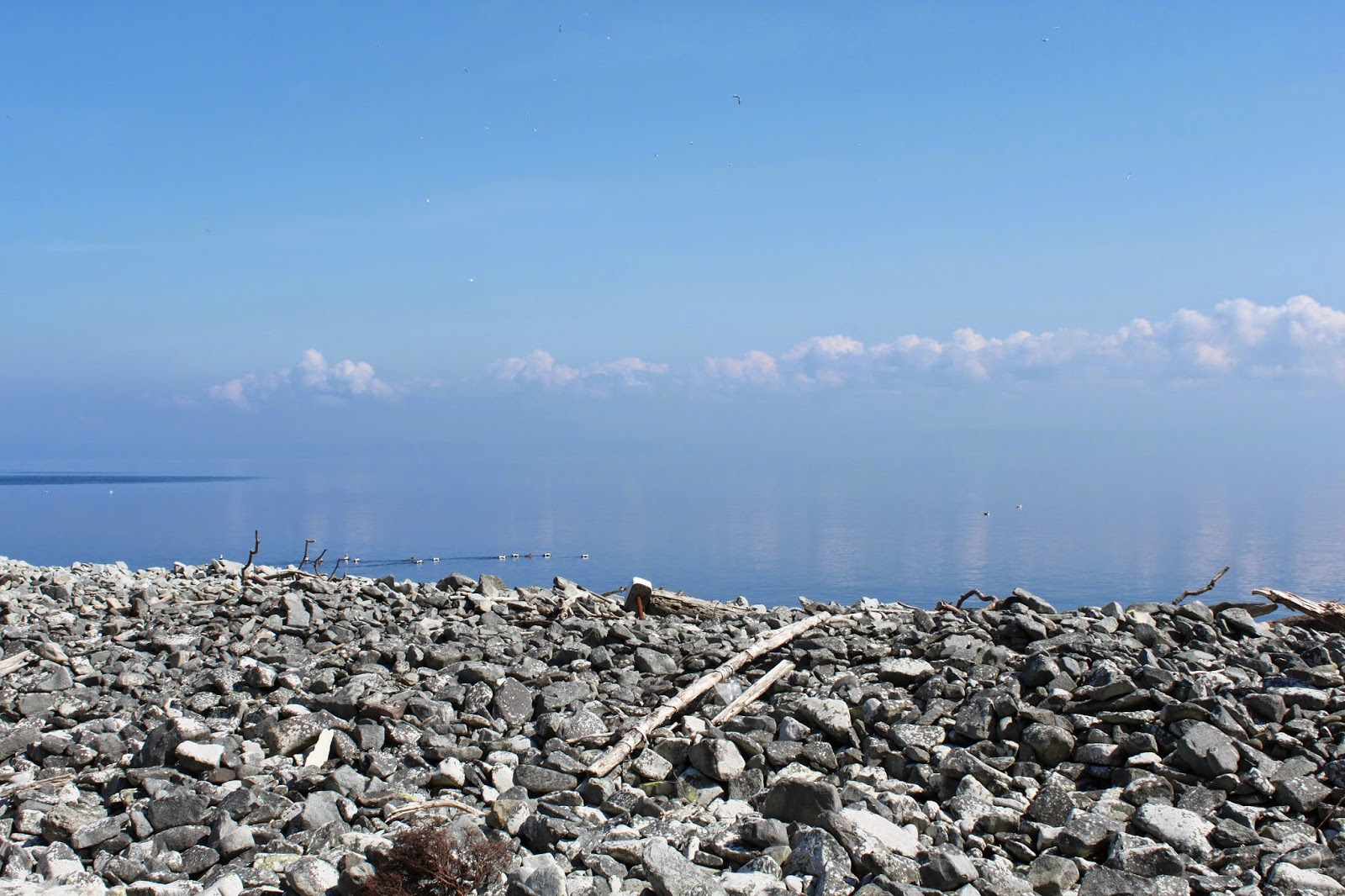
It is possible, when the weather is kind, to land on the east of the island where there is a boulder field scattered with the remains of old industry from the days when curling stones were quarried and shaped here. Ailsa Craig is formed of a unique type of granite that has pink, blue and green tinges.
 
The pebbles felt as smooth as marble and warm as new baked loaves. 


 Russell and Elspeth, captains and crew of Ocean Breeze, are full of knowledge about all aspects of the island and their insights into the unusual physical features of gannets, and their even more unusual  family lives, are fascinating.


The whole day: the gentle sea, the serene gannets and the warm spring sunshine all left me feeling equally serene and full of wonder after my glimpse into the lives of Arran's nextdoor neighbours.


Tuesday, 22 April 2014

Laggantuin


Laggantuin


Ian Hislop said on television last week that he believes that the British obsession with history arises from nostalgia for a golden age that never actually existed. As you’ll know if you read my blog regularly I am fascinated by history but I have never wanted to turn the clock back. It seems to me that, in the past, if you were a man you were likely to die in bloody battle and if you were a woman you were likely to die in bloody childbirth- thank heavens for being alive in the 21st century! For me the fascination is to do with understanding why things are as they are today whether it’s in a family, local or global sense. It’s about recording and remembering so that the past isn’t lost for ever.

History is written all over Arran’s landscapes in buildings, ruins, earthworks and place names. I recently scrambled up to the ruins of Laggantuin- an old clachan, or cluster of homes, huddled in a sheltered bowl of hillside on the coastline north of Sannox. It is said that, long ago, islanders were able to hide from Viking raids there, concealed by a lip of land. Today you can still see the ruins of their blackhouses- long one-storey buildings in which families lived at one end and animals at the other- and the characters and conversations of the past can seem almost present. The land was farmed on the runrig system with each family cultivating strips of land which were rotated annually. Labour and implements were shared. As a way of life it had successfully supported the island population for millennia, although it would have been a harsh existence by modern standards and the people possessed little. Everything changed with the agricultural improvements of the late 18th century when the modern capitalist world extended its reach over the old communal ways and the inhabitants of Laggantuin were cleared out to make way for sheep farming.

Some of the displaced islanders went to Megantic County in Canada, some to Glasgow. A few were able to stay on Arran as fishing crofters. But sheep farming did not bring the prosperity that had been hoped for and much land that had been enclosed and managed reverted to a wild state. Look out for old enclosure walls all along the coast from Sannox to Lochranza. Ironically, today in Lochranza the hill sheep seem as if they must have always been here and the place certainly wouldn’t be the same without them and their lambs on the golf course in April and sleeping on the Boguille road at night. I wonder what traces the 21st century will leave behind? Something that future generations will enjoy but most of us alive now will never see is being created at Sannox this year, in fact you will see its beginnings as you walk to Laggantuin. The coniferous forest is being felled and native broad-leaved tree species are being planted by the Forestry Commission. Timber will be shipped out from a new platform. Sometimes history holds up the best practices for the future.