Our website

Visit our website at www.arran-campsite.com
and our Blog of our
"World tour of Scotland" at www.nigelandkathyinscotland.blogspot.com

Thursday, 14 February 2013


Something old, something new

I thought you might like to see this photo of our new toilets cabin arriving on the campsite (made by Wintech Ltd and very nice indeed). I wonder what the eagles made of it all. In this wild and natural part of the world, life often throws up such strange juxtapositions of old and new. Recently, I visited Dumbarton Castle which is situated on a fortress rock in the Clyde. Nowadays its parapets overlook Dumbarton’s football pitch- and prove useful to those who’ve left it too late to buy a ticket.

In the three years I have lived in Lochranza my perception of time has undergone a paradigm shift. This may be because of all the exciting geology in the area which confronts you in measures of millions of years, such as the footprint trail of the giant millipede across the rocks at Laggan from 250 million years ago. The past is here in the present.

Of course we are all living in exciting times of scientific discovery about the entire universe, and when Brian Cox presents new theories they come in trillions of years. No wonder that when the 500 year old skeleton of England’s Richard the Third was found, it seemed as if his final battle was a recent event and we almost knew him! Another exciting debate of our time is that regarding Scottish Independence. Applying geological time to this matter tells us that it’s a mere 700 years or so since the Scottish/ English border was defined (roughly the age of Lochranza Castle) and only a few thousand since the island of Britain did not exist but was joined to mainland Europe. The 300 years since the United Kingdom was formed is less than ten generations away.

As fast as new discoveries are made, old theories are demolished. For example, experts now say that Britain was actually never covered in woods which were quickly cleared by humans. In fact, careful human management of the forested areas by such practices as coppicing helped them to survive. Most of the landscapes we celebrate for their apparent wildness look as they do due to the activities of humans and their grazing by farm animals. Around Lochranza, black cattle used to tread the hillsides keeping intrusive vegetation at bay, crofters dug a network of lades to drain the boggy ground, and also built dry stane dykes. It all helped to create varieties of habitat which in turn attracted more varieties of wildlife, and shaped our favourite landscapes.

It’s good to keep moving so here’s to new theories – and the next time that you feel the earth under your feet shift a little just remember that it’s quite possible in Lochranza.

Here’s the enduring face of the Sleeping Warrior, sentinel of the north end of Arran, weathering the frost and ice…… at least for the time being.


Friday, 4 January 2013


“I get all the news I need from the weather report”
(Paul Simon)
or
Tracy’s Road Trip to Switzerland
or
Motorhoming in Winter

We planned our December 2012 road trip to visit Emily (daughter) and partner Tim in Zurich to take in Oberried in the Black Forest and picturesque Gruyeres in French-speaking Switzerland. Our journey began, or rather didn’t, with the Arran ferry cancelled due to high winds, but in a camper van you can always sit and read a good book until the weather improves. When we got to the mainland in the dark we met deep puddles in every dip of the road. Two weeks later, on the return journey through Belgium, conditions were exactly the same- so it clearly wasn’t just Britain disappearing underwater this winter.

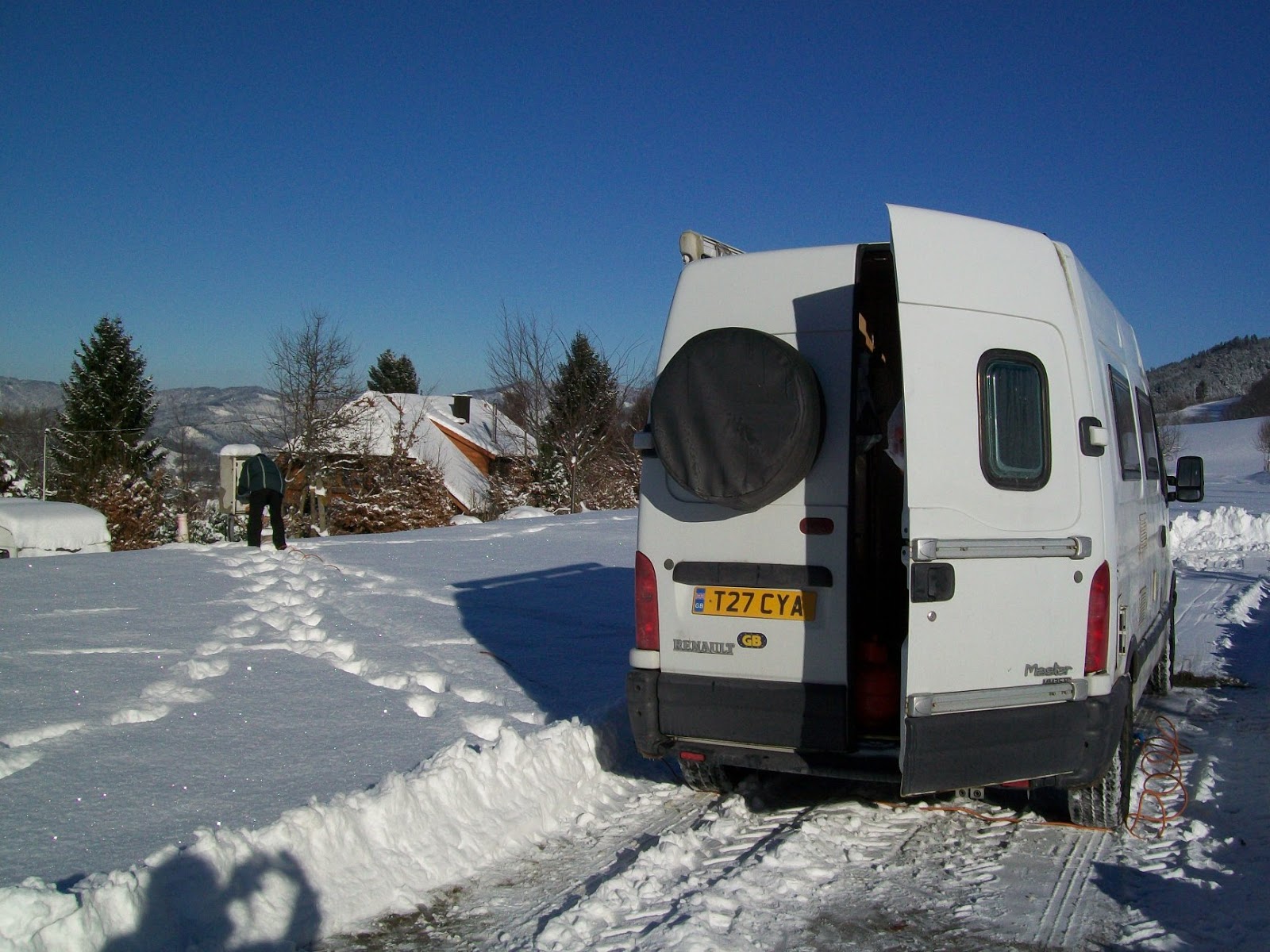
Poor Tracy the camper van suffered from travelling many extremely wet roads. However, she never actually let us down and trundled back to Lochranza dutifully in time for us to celebrate Hogmanay in the Lochranza Hotel as usual. (Our camper van’s called Tracy by the way, because it’s easier to say Tracy than camper van and because we were told by her previous owner that the number plate in fact spells Tracy: T27CYA !?)

December 2011 gave us an easy breaking in to winter motor-homing- I remember we had to rip off our thermal underwear on a Swiss mountainside to avoid passing out with heat exhaustion! This year the weather challenges continued. We arrived at the gate of Kirnermartes Campsite in the Black Forest on a dark, snowy evening when we were relieved to find that we were following the snow plough uphill. A heavy fall of fresh, deep snow had obscured all tracks, boundaries and definitions and we were not prepared to experiment with seeing if Tracy could get through knee-deep snow. The most sensible solution seemed to be to go to bed where we were and we slept very soundly and cosily indeed. Next morning I awoke to messages from my nose telling me that it was unusually cold. Minus eleven in fact. We soon discovered that our shoes were iced to the floor, everything liquid had frozen including the water heater, my flannel was stuck to the sink…… and Tracy’s engine was dead.

Scraping Jack Frost off the windows we looked out at a beautiful scene of snowy mountains, wooden chalets and a bright blue sky. Like Lochranza in winter though, it would be some time before the sun would peep above the mountains to defrost us. Fortunately, before long, the farmer who runs the campsite came along with his tractor to clear a space for us near to a hook up. If he was thinking, “Typical Brits- brought to a standstill by a bit of snow” he was too polite to show it.

In the village cafĂ© we warmed up with a huge, home-made waffle with a hot baked apple sitting on it that was stuffed with raisins, cinnamon and marzipan and drenched with vanilla icecream. Then back at Kirnermartes Campsite we enjoyed a sauna in the brand new wellness suite which has been created in the farm basement. Smells of schapps brewing (if that’s the right word) wafted out from one of the farm buildings.

Next day, serendipitously, a thaw began and Tracy’s engine rumbled into life, though the water heater would remain frozen throughout our tour and journeys were punctuated by Nigel trying to wring water out of the air filter.

We had a lovely time despite the engine problems, and feel that camper-vanning is an ideal winter holiday option for us.  If you’re looking for Christmas atmosphere, the Grimm’s fairytale scenery and medieval villages, with their traditional Christmas markets, make this part of Europe- Switzerland, the Black Forest and Alsace- hard to beat. If you do head for these parts, do research driving regulations for the different countries carefully- for example, in Germany winter tyres are compulsory in winter but not snow chains; in Switzerland it’s compulsory to carry snow chains and it’s also compulsory to buy a vignette for 40 Swiss francs to travel on Swiss motorways (which are hard to avoid). If you get these things wrong and have to be rescued, you will be fined. On the other hand, and maybe because it’s a quiet time of year for travel, we never experienced anything other than courteous, considerate behaviour in all our continental driving.

 
 This is a reconstruction of a prehistoric village near Lake Neuchatel. Our ancestors had sensible building designs for wet times!


Tuesday, 4 December 2012


There are more Questions than Answers

The winter months are a time when I enjoy thumbing through Arran walks guides to pick out some new routes. I always like to have something of historical interest on my walks, and on Arran that’s not difficult.

You are never far from the past on this island with its hillsides that positively bristle with prehistoric standing stones and the remains of ancient chambered cairns. You sometimes have to do a bit of hunting for them though; they’re not publicised and packaged up, but then again, nor do they have entrance fees. The guidebooks and the Isle of Arran Heritage Museum are good places to seek inspiration.

On Arran, you can trail your fingertips softly across stones shaped by people with flint tools 4,000 years ago. However hard you try to visualise the particular hand that shaped the stone and the intent, individual face concentrating on the task in hand, they stay tantalisingly beyond reach, but it still feels like a connection across the centuries. No doubt their genes live on in some of the families that remain on the island today. Coming from the Yorkshire coast, it is unlikely that my ancestors set foot on the island, but you never know; jet, maybe from Whitby, has been found in the prehistoric landscape at Kilmartin, just north of here over the Kilbrannan Sound. Humans were designed to travel the face of the globe it seems,

The photos show some rock art of 4,000 years ago in a wood near Brodick. The symbols are known as cup and rock marks. No one knows for sure what they represent. To me, they echo the design of stone circles with their rings within rings, often situated close to river valleys. I like the theory that it all symbolised the womb of mother earth, to which the dead were returned in foetal positions.

I recently met a man from New York whilst having a cup of coffee in the Stags Pavilion who informed me he was a leading expert on ancient history and was currently preparing a lecture on whether it’s correct to have the prefix  Mac or O before Scottish names e.g. MacDonald / O Donnell. He also claimed to know the exact reason for cup and ring marks.

Wait for it!

According to him, prehistoric woman discovered the secret of growing giant vegetables. She planted them on rocks in order to replicate drought conditions, which made the tubers work harder to find water, growing huge in the process- the cup marks being the dints made by these supersize vegetables.


I think I met an expert in Tall Tales.


Friday, 23 November 2012


It's not easy to make out, but the photo shows a rescue helicopter airlifting a patient to the mainland from the village football field, as sometimes happens.

We’re Prepared.

Island life. There’s a lot of gossiping. It travels faster than Facebook, and, like Facebook, the truth of the tale can be lost in the telling and then there’s bother! But helping your neighbours out when they’re in trouble goes without saying. You don’t throw anything away because where’s it going to go? And when you go shopping you get plenty in, in case the ferry doesn’t sail for a few days.

On an island like Arran, with a permanent population of less than 5,000, you are a big fish in a small pond. It’s a long way from the rest of our overcrowded world in which we can feel like very small anonymous fish indeed. This situation translates into an island lifestyle which demands that everyone has to get stuck in to make island life work. The last thing island life is, is a retreat.

Cue First Responders.

Last year Nigel and I joined the team of First Responder volunteers covering the North End of Arran. First Responders are people trained in the use of a defibrillator, which can shock start someone’s heart, and also in giving oxygen. Once or twice a week for a 24 hour period at a time, as a First Responder you are in charge of a bag containing the defib, the oxygen canister, masks, airways and first aid equipment. You agree to be at home and available to drop everything on receiving a call from ambulance control. You need to have use of a car. Every minute counts in surviving a heart attack and, as the only hospital on Arran is at Lamlash, 45 minutes away from Lochranza, First Responders can give vital help to someone suffering breathing difficulties until the ambulance arrives.

The fire service, the coastguard service and the mountain rescue team on Arran are all made up of committed volunteers who also have day jobs and businesses. Two of our friends, as well as working, belong to the Fire Service, the Coastguards and First Responders. They are self-employed so a lot of call-outs can have an impact on their businesses, but without the likes of them, island life would become unsustainable.

Island life. You join in.


Sunday, 14 October 2012


My favourite time of year

In my mind early October and late May battle it out for the loveliest time of year. Lately, night skies have been peppered with stars and the Milky Way has been clearly visible. The symphony orchestra of stags has continued to blare out around the clock. (The stags have stationed themselves on crags around the glen for maximum impact.)

The bracken on the hillsides is sinking down in a blaze of fiery gold and the rowans are laden with glossy clusters of berries  In May 2011 I wrote a blog about the devastating effects of a powerful wind we had, which turned all the trees prematurely brown. But nature is clearly putting tree survival to rights with this bumper crop. Half a dozen basking sharks have been cruising up and down the coast between Lochranza and Catacol, and the little ferry to Claonaig has detoured a couple of times to see them.

The fine weather has given us chance to get started on the autumn task of clearing out the ditches but yesterday we took some time off to walk the classic Cock of Arran route, heading up from the campsite and across to Laggan then returning along the coast. Above the Narachan (the old track above the campsite) a stag with a small group of hinds kept us under close watch. We could sense his tension and didn’t linger to agitate him more. Up above, a croaking raven was chasing a golden eagle until the eagle caught a thermal and rose serenely higher and higher.

This route is full of historical and geological interest that I have described in earlier blogs: prehistoric giant millipede tracks, centuries- old graffiti in Ossian’s cave, the Cock of Arran itself, Hutton’s Unconformity and more. At Fairy  Dell, where there is a choice of paths home, we chose the North Newton route because we knew we could get choc ices from Reg at the Whins and eat them whilst having a rest and watching the seals on the rocks below. Incidentally, Kitty, who is 81 and has lived in Lochranza for most of her life, says that what is commonly called Fairy Dell is really Dairy Puddle.

Today it’s raining but I’m pleased to report that our newly cleared ditches seem to be working. The weather hasn’t dampened the testosterone-charged atmosphere we inhabit just now. I am reading “The Sea Kingdoms” by Alistair Moffat which discusses Celtic Britain, but not as something past and gone, but something very much alive in the west. Many of us will be following a Celtic tradition soon with turnip lanterns for Hallowe’en. I hadn’t realised that the originals 2,000 years ago were the skulls of enemies stuck on posts to make ghost fences for protection!

The pictures show: Laggan cottage, the Cock of Arran (something else that lost its head some time ago) and the view from the Whins.

Monday, 1 October 2012

What do campsite wardens do on holiday?


I love camping, and always have. I never sleep so well as when I am camping, and if it’s a wet, wild night and I’m snuggled in my sleeping bag in our small green tent, I sleep even better.

A problem until now for us in our three years of running the campsite has been, ironically, lack of camping. Three years ago we spent two entire months kayaking and living in a small tent in a very wet and windy summer in the Scottish islands. Now, our time off comes from November to February but the little Calmac ferries, which stitch the islands together in summer, will soon be heading up the Clyde for the winter. Seizing the moment before this happens, and leaving campsite-sitters Carol and Alan in place, we finally went camping again, heading north to Knapdale.

A good thing about living in a place of islands and remote peninsulas is that you don’t have to go far to be somewhere completely different. Knapdale is an area of long sea lochs and ancient woodlands, and if you like the wild nature of Lochranza, you would like this area too. We sea kayaked round the Faery Islands, looked for signs of beavers, felt very small watching the awesome power of the tide rushing past Jura, and put a foot in the footprint on the (replica)Stone of Destiny at Dunadd, where Scotland’s earliest kings were crowned.

We stayed at Leachive Campsite in the attractive village of Tayvallich. I’ll wild camp if I’m on a mountain or sea kayak journey far from civilisation, but I don’t find sleeping on boggy tussocks relaxing, nor digging a hole every time nature calls. I positively enjoy the quirky nature of small campsites. Leachive Campsite itself was a very pleasant base, right in the middle of the village and close to the water’s edge.

It was all happening in the Kilbrannan Sound on the way home to Lochranza, with porpoises and a basking shark swimming unconcernedly beside the boat.

Wednesday, 22 August 2012

Lochranza in August


August is Arran’s busiest time of year and this year it has come with many days of warm sunshine. Evenings have found the red deer cooling off in the loch. Inspired by their example, on hot afternoons we have plunged into cold pools up in the glens, whilst back on the campsite, campers and red deer can be seen snoozing alongside each other.

Every summer, the local PGL geology field centre organise ceilidhs in Lochranza Village Hall. If you’ve never been to a ceilidh, this is an initiation not to miss. A ceilidh is a traditional get-together with songs and dances, and the Arranach Ceilidh Band who provide the music for Lochranza ceilidhs, are a positive treat to the ears. Chris Traill is the caller, guiding you through the old Arran, Scottish and Irish dances. Ceilidhs vary on a scale from exuberant to wildly riotous; the dancers from toddlers to the very old. You’ll find that moving so fast means the summer midges certainly won’t catch up with you!